The First Hack Happened in 1834. And They Got Away With It.
Nearly two centuries before ransomware, phishing and computer viruses, two French brothers discovered how to exploit a government communications network to make money on the stock exchange. Their scheme involved bribery, secret signals and a rather ingenious use of an error-correction system. The remarkable part? When they were caught, the law struggled to find a crime.
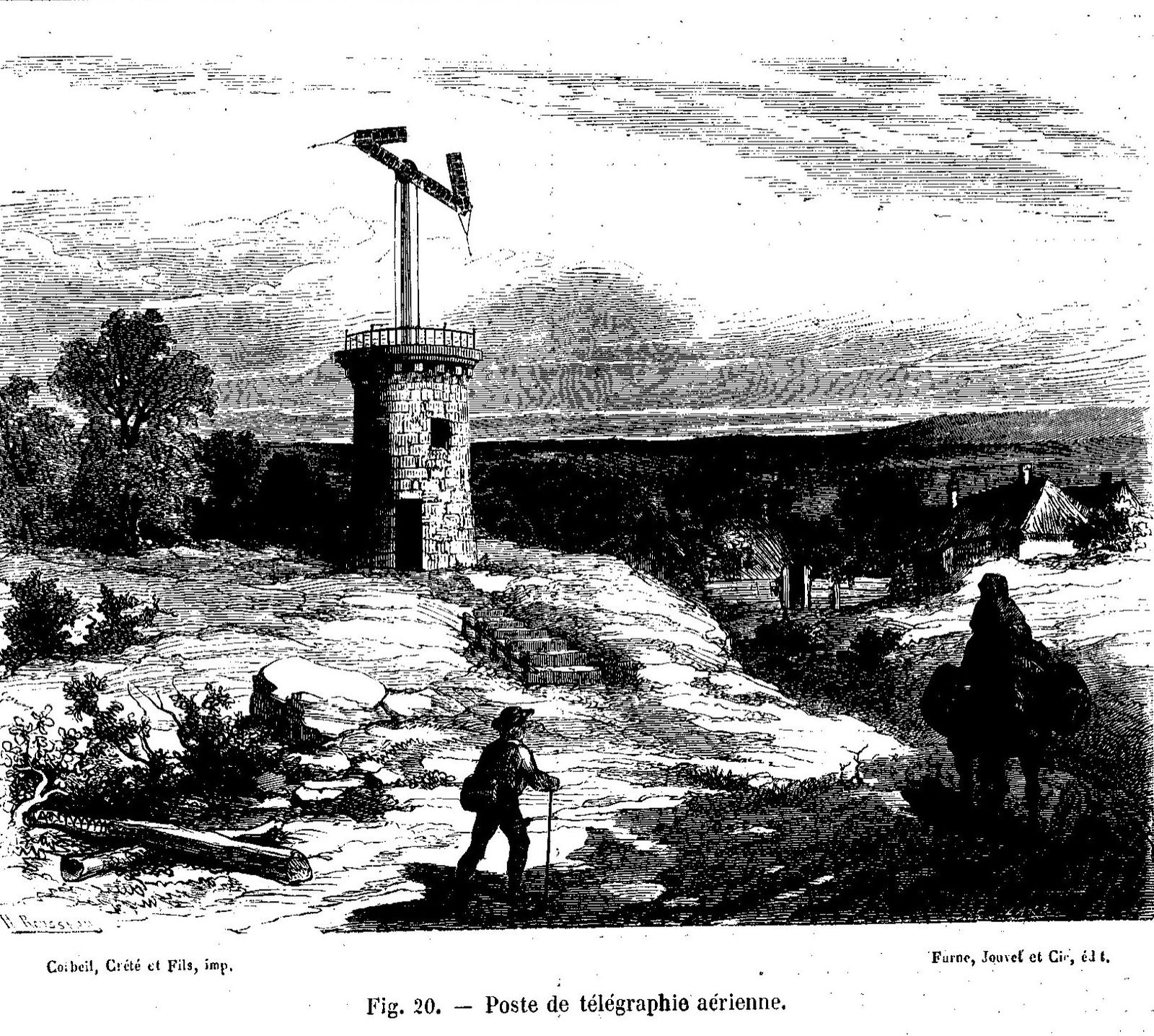
A Chappe optical telegraph station. Illustration from Louis Figuier, Les merveilles de la science (1868), via Wikimedia Commons, public domain
In August 1836, the French authorities uncovered something rather embarrassing.
For two years, a pair of brothers trading on the Bordeaux stock exchange had been receiving financial information from Paris faster than almost anybody else. They had not invented a faster carriage, trained particularly talented carrier pigeons or developed some remarkable ability to predict the markets.
They had found a way into France's government telecommunications network.
Their names were François and Joseph Blanc, twin bankers from Bordeaux, and their operation had begun in 1834.1,2 By exploiting a weakness in the country's optical telegraph system, they were able to obtain advance information about movements in Parisian government bond prices.
It was, in several respects, a remarkably modern operation. They recruited insiders, manipulated legitimate network traffic, concealed their messages and turned privileged access to information into financial gain.
There was just one significant difference from the cyberattacks we recognise today.
The network didn't use electricity, let alone computers.
And when the brothers eventually stood trial, they escaped criminal punishment.
The internet before electricity
To understand how the Blanc brothers pulled off their scheme, we need to return to a France in which sending a message across the country was still an exercise in patience.
In the early nineteenth century, information travelled largely at the speed of a horse. Letters moved by post, commercial news arrived by carriage, and financial traders outside Paris had to wait for updates from the capital.
For anyone buying and selling government bonds, that delay mattered.
Knowing whether prices had risen or fallen in Paris could provide a significant advantage when trading elsewhere. But by the time that information reached Bordeaux, it could already be several days old.
France, however, possessed a technological marvel that could transmit messages across enormous distances in a fraction of that time.
The optical telegraph.
Developed by Claude Chappe and his brothers in the late eighteenth century, the system consisted of towers positioned within sight of one another. Each tower had mechanical arms that could be arranged into different positions to represent coded signals.
An operator would observe the previous tower through a telescope, reproduce the signal using the arms on their own tower, and pass it onwards to the next station.
It was an early national communications network, operating decades before the widespread adoption of the electric telegraph.
The system was impressive, but it came with a restriction that would prove important to our story: it was reserved for government use.
Private citizens, including financial traders, couldn't simply pay to send messages across it.
The Blanc brothers decided to find another way.
A pair of gloves, a pair of stockings and a very useful accomplice
The brothers were financiers operating in Bordeaux, a major commercial centre in southwestern France.
Their problem was straightforward. Paris was the country's principal financial market, but the information they needed arrived too slowly.
Their solution involved three locations: Paris, Tours and Bordeaux.
First, they arranged for an agent in Paris to monitor movements in government bond prices. When the market moved significantly, that agent sent a coded parcel to Tours.
The contents were wonderfully ordinary.
According to the instructions later produced in court, gloves meant that government bonds had risen, while stockings meant they had fallen.1,2
There was nothing especially sophisticated about the objects themselves. Their importance was that they carried information in a form the intended recipient could recognise.
That recipient was a telegraph official in Tours.
The brothers had bribed people with access to the government's optical telegraph network, including a telegraph operator named Pierre Guibout.2 In return for payment, the conspirators inserted signals into legitimate government transmissions travelling towards Bordeaux.
But they didn't simply replace official messages with stock market news.
They used a more ingenious technique.
Hiding information inside an error
The optical telegraph network needed a way to deal with mistakes.
Operators were responsible for repeating mechanical signals across considerable distances. Errors were inevitable, particularly when weather conditions were poor or visibility was limited.
The system therefore included a correction procedure.
If an incorrect signal was transmitted, an operator could follow it with a special error signal indicating that the previous character should be disregarded.
For the Blanc brothers, this presented an opportunity.
Their accomplice in Tours would insert a deliberately incorrect signal into an otherwise legitimate government message. The false signal represented information about the financial markets.
Immediately afterwards, the operator transmitted the official correction signal.3
To anyone reading the final decoded government message, the extra information effectively disappeared. The erroneous character was cancelled, leaving the authorised message intact.
But the physical signal had still travelled through the network.
That was the weakness the brothers exploited.
At the Bordeaux end, an accomplice could observe the mechanical arms through a telescope and identify the deliberately inserted signal before it was discarded during decoding.
The government message arrived as intended.
The secret financial message arrived too.
It was a way of transmitting unauthorised information through a legitimate communications system without permanently changing the official message.
Today, a security researcher might describe something similar as a covert channel: a means of carrying information through a system in a way its designers hadn't intended.
The terminology is modern, but the principle is recognisable.
The Blanc brothers had discovered that the network's mechanism for correcting errors could also be used to hide messages.
And the scheme worked.
Two years of getting ahead of the market
From 1834 to 1836, the brothers used their arrangement to obtain financial information before it arrived through ordinary channels.
The advantage might have been measured in hours or days rather than milliseconds, but in nineteenth-century financial markets that could be extremely valuable.
They could act on movements in Paris before other Bordeaux traders knew what had happened.
Historical accounts describe substantial profits, although the exact amount attributable to the scheme is difficult to establish confidently.
The operation was also more organised than the familiar image of a lone hacker exploiting a technical weakness.
It involved an agent collecting information in Paris, people arranging coded deliveries, compromised telegraph personnel in Tours and an accomplice observing signals in Bordeaux.
Each participant had a role.
The brothers did not need to understand every aspect of the telegraph network themselves. They needed to identify where trusted access could be purchased and how information could be moved through the system.
For roughly two years, the arrangement continued.
Then the human element that had made it possible helped bring it down.
The problem with trusting people to keep secrets
The scheme came to light in 1836 amid personnel changes and revelations involving the telegraph staff at Tours.
Accounts differ in some of their details, but the essential point is clear: the operation was exposed through people, rather than through a technical security system detecting unauthorised signals.
The authorities investigated, and the brothers and their accomplices faced prosecution.
It was an extraordinary case for its time.
The French government had built a communications system that ordinary citizens were not supposed to use. The defendants had secretly exploited that system for private financial gain, using bribed officials to transmit messages disguised as mistakes.
Surely that was illegal?
Not quite as straightforward as it sounds.
The trial that exposed a gap in the law
The proceedings took place before the criminal court in Tours from 11 to 14 March 1837.2
The prosecution faced an awkward problem. The defendants' conduct was plainly contrary to the intended use of the government telegraph, but the relevant criminal law had not been written with this sort of interference in mind.
One important question concerned whether the bribed telegraph official had been paid to perform an act belonging to his official duties.
The jury accepted that unauthorised signals had been transmitted and that payments had been received. But it did not accept the necessary legal characterisation of the conduct as an official act for the bribery offence.
The distinction was decisive.
The brothers and the implicated official were not criminally convicted. They were ordered to pay the costs of the proceedings, but escaped the punishment the authorities had sought.2
That outcome is sometimes summarised as the brothers being acquitted. More precisely, contemporary and later French accounts describe an absolution: the underlying conduct was established, but the legal elements required for criminal punishment were not satisfied.
It is an important distinction, particularly when telling a story that has become part of cybersecurity folklore.
The brothers had not demonstrated that manipulating a communications network was harmless or acceptable. They had demonstrated that the law was not adequately equipped to punish it.
France was already moving to close the gap. A law of 2 May 1837 made it a crime to transmit signals without authorisation, by telegraph or any other means, with prison terms of up to a year.1,2
The technology had created a new opportunity for abuse, and the legal framework was struggling to catch up.
That should sound familiar.
Was this really the world's first cyberattack?
This is where the history becomes especially interesting.
The Blanc brothers' operation is frequently described as the first cyberattack, including in a 2018 discussion by security expert Bruce Schneier, drawing on an account by technology writer Tom Standage.3
It's an appealing description.
There was a communications network. There were trusted operators. There was unauthorised manipulation of transmitted information. And there was a clear financial motive.
In modern cybersecurity language, the case contains elements of insider compromise, information leakage, covert communication and abuse of a system's error-handling mechanism.
But calling it the world's first cyberattack requires some caution.
The word cyber belongs to a much later period, and there is no universally accepted definition of a cyberattack that comfortably includes every form of historical communications fraud.
Humans had been intercepting messages, manipulating signals and exploiting trusted messengers for centuries before the optical telegraph existed.
The Blanc brothers were certainly not the first people to use communications technology dishonestly.
What makes their case distinctive is the way they exploited the technical rules of an organised telecommunications network.
They weren't merely bribing someone to disclose a secret document. They were embedding unauthorised information inside legitimate network traffic and using the system's own correction procedure to conceal it.
That is why the episode deserves a place in the history of cybersecurity, even if describing it as the first cyberattack is ultimately a matter of interpretation.
The security lessons haven't aged much
Strip away the telescopes, mechanical arms and nineteenth-century financial markets, and the Blanc brothers' scheme raises several questions that modern security teams would recognise immediately.
The first is the danger of insider access.
The brothers didn't have to break into a telegraph tower or defeat an elaborate technical safeguard. They persuaded people who were already authorised to operate the system to misuse that access.
The second is the problem of unintended communication channels.
The optical telegraph's correction procedure existed to improve the accuracy of government messages. It was not designed to transmit private information. Yet the brothers found a way to use it for precisely that purpose.
The third is that a system can function exactly as designed while still being exploited.
The government messages continued to reach their destinations. The correction signals did their intended job. From the perspective of the official message, the system could appear to be operating normally.
The compromise lay in what an observer could learn from the signals along the way.
And finally, there is the question of regulation.
Technology frequently develops capabilities before lawmakers fully understand how those capabilities might be abused.
The Blanc brothers encountered a legal system that could establish much of what they had done but struggled to attach criminal liability to it.
Nearly two centuries later, governments continue to confront versions of the same problem when dealing with emerging technologies.
The oldest trick in a very modern industry
There's something wonderfully fitting about the possibility that one of cybersecurity's earliest recognisable incidents involved two financiers, a few items of clothing and a government employee willing to accept a bribe.
No malicious software was required. There was no computer to infect, no password to steal and no internet connection to exploit.
The brothers found a system that people trusted, identified a feature that could be used for something its designers hadn't intended, and recruited insiders who could make it happen.
For two years, they turned that weakness into a commercial advantage.
When they were finally caught, the law had trouble keeping up.
The technology has changed beyond recognition since 1834. Communications now travel across continents almost instantaneously, and financial markets operate at speeds the Blanc brothers could scarcely have imagined.
But the central idea behind their scheme remains surprisingly contemporary.
Sometimes, compromising a network isn't about breaking the machinery.
It's about understanding how the machinery works, and finding a way to make it do something nobody thought to forbid.
Editorial note: the title uses "hack" in its modern, retrospective sense. The 1834 incident involved an optical telecommunications network rather than a computer, and its status as the world's first cyberattack is an interpretation rather than an established historical fact.
Corrections: none. If you spot an error, tell us and we will correct it openly.